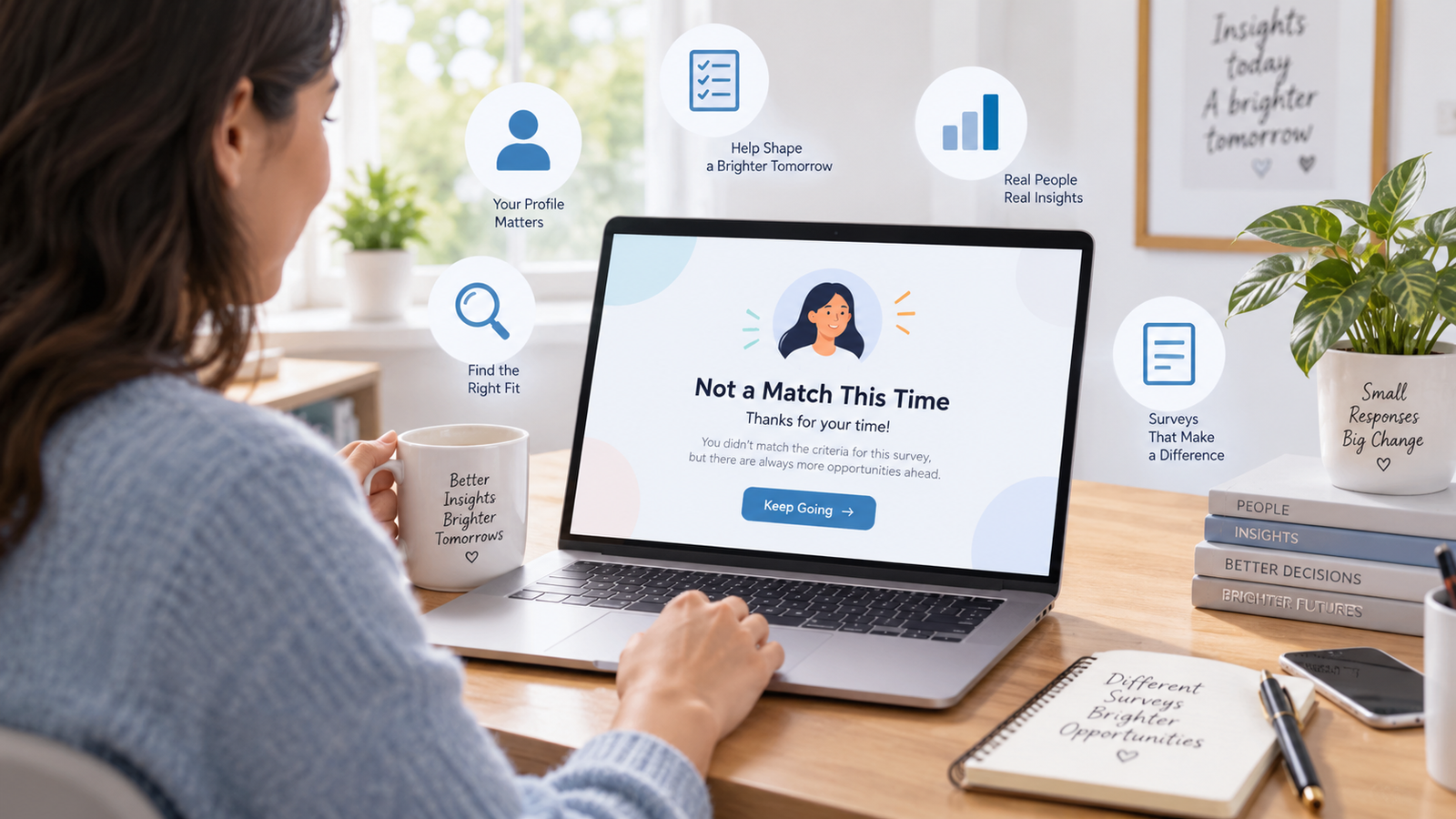
You find a survey that looks promising, answer a few questions about your age, shopping habits, or household, and then suddenly see a message such as:
“Sorry, you don’t qualify for this survey.”
If that has happened to you more than once, you are definitely not alone.
Getting disqualified from paid surveys can be frustrating, especially when you have already spent several minutes answering questions. It may even make you wonder whether you did something wrong or whether the survey website is legitimate.
In many cases, however, survey disqualification is simply part of how market research works.
Researchers are usually not looking for responses from everyone. They may need opinions from a very specific group of people—for example, parents of young children, recent car buyers, streaming-service subscribers, business owners, or people living in a particular country.
If your profile does not match what the study needs, the survey may end early.
That does not mean every screen-out is reasonable, and it does not mean you should ignore poor survey experiences. But understanding why disqualification happens can make paid surveys much less confusing.
In this guide, we’ll look at nine common reasons people get disqualified from paid surveys, what you can do to reduce unnecessary screen-outs, and when repeated disqualifications may be worth paying closer attention to.
Quick note: Paid surveys are best treated as a way to earn occasional rewards in your spare time. Survey availability, qualification rates, and rewards vary by platform, profile, location, and current research demand.
What Does It Mean to Be Disqualified From a Survey?
Survey disqualification—often called a screen-out—means that you do not meet the requirements for a particular research study.
Before showing you the full questionnaire, researchers often ask a few screening questions.
These might cover things such as your:
- Age
- Location
- Employment
- Household
- Shopping habits
- Technology use
- Recent purchases
- Interests
The purpose of these questions is usually to determine whether you belong to the audience the researcher wants to study.
For example, imagine a company wants feedback from people who purchased a washing machine within the last six months.
If you answer that you have not purchased a washing machine recently, you may be screened out immediately.
You did nothing wrong. You simply were not part of that study’s target group.
The confusing part is that the exact requirements are usually not shown in advance. If participants knew exactly who researchers were looking for, some people might change their answers just to qualify.
That is one reason screeners exist.
1. You Don’t Match the Target Demographic
This is probably the most common reason for getting screened out.
Researchers often need responses from a specific demographic group rather than the general public.
A study might need:
Women aged 25–44 who regularly buy skincare products.
Another might need:
People who own a small business with fewer than 20 employees.
Another could be limited to:
Parents who purchased baby products within the last three months.
If you do not match those requirements, the survey may end after only a few questions.
You cannot realistically qualify for every study.
In fact, if a survey platform claimed that every user qualifies for every survey, that would be something worth questioning.
The best approach is simply to answer demographic questions accurately and accept that some studies will not be a match.

2. The Survey Already Has Enough Participants Like You
Sometimes you actually match the target audience, but the researcher has already collected enough responses from people with a profile similar to yours.
This is known as a quota.
For example, a company might want:
- 200 responses from men
- 200 responses from women
- 100 participants aged 18–24
- 100 participants aged 25–34
Once one of those groups is full, additional participants in that category may be screened out.
This can explain why a survey appears available when you open it but closes shortly afterward.
It may also explain why two people with similar profiles have different experiences with the same survey.
One person may have joined while the quota was still open. The other may have arrived after it was filled.
3. Your Location Doesn’t Match the Study
Your country—and sometimes your state, region, or city—can significantly affect which surveys are available to you.
Market research is often location-specific.
A supermarket chain operating only in the United States has little reason to survey consumers living in a country where its stores do not exist.
Similarly, researchers studying mobile networks in Canada may specifically need Canadian residents.
This is why survey availability can look very different from one country to another.
If you see someone online saying they receive many surveys from a particular platform, that does not necessarily mean you will have the same experience in your location.
Before joining a survey platform, check whether your country is officially supported.
You can also use Ravtar’s location-based resources to compare survey options that may be available in different regions.

4. Your Survey Profile Is Incomplete
Many survey platforms include a profile section where you can provide general information about yourself.
It may ask about your:
- Household
- Job
- Education
- Technology
- Vehicles
- Shopping behavior
- Entertainment preferences
This profile information can help the platform match you with relevant studies before sending an invitation.
If your profile is incomplete or outdated, you may receive surveys that are poorly matched to you.
For example, if your account still says you do not own a car but you purchased one last year, you may miss studies looking for vehicle owners.
Take a few minutes to review your profile occasionally.
Keep it accurate, but do not change information simply because you think a particular answer will produce more surveys.
Accuracy matters more than trying to guess what researchers want.
5. Your Answers Are Inconsistent
Survey platforms and research companies care about response quality.
If your answers regularly contradict information you previously provided, a survey may end early.
Imagine that your profile says you are 32 years old, but a screening question suddenly receives an answer suggesting you are 48.
Or perhaps you previously said you have never owned a vehicle, but later claim that you purchased a new car two months ago.
Occasional mistakes happen, of course.
But repeated inconsistencies can make responses look unreliable.
The simplest solution is also the best one:
Answer honestly and consistently.
Do not try to remember what you think a survey “wants” you to say. Just answer based on your actual circumstances.
6. You Are Completing the Survey Too Quickly
Everyone reads at a different speed, but rushing through surveys can sometimes create quality concerns.
Research questionnaires are designed with an expected amount of reading and thinking time.
If a 15-minute questionnaire is completed in two minutes, the system may interpret that as a sign that the participant is clicking through questions without properly reading them.
Some surveys use automated quality checks that consider completion patterns.
That does not mean you need to deliberately complete surveys slowly.
Simply read each question, consider your answer, and move at a normal pace.
Trying to finish as fast as possible can cause mistakes anyway.
And in surveys where responses are used to influence products, services, or research decisions, thoughtful answers are more useful than rushed ones.
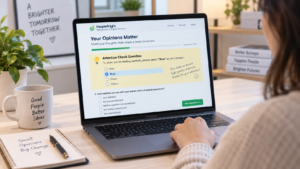
7. You Missed an Attention-Check Question
You may occasionally come across a question that seems strangely obvious.
For example:
“To show that you are reading carefully, please select ‘Somewhat Agree’ below.”
That is an attention check.
Researchers use these questions to identify participants who may be clicking answers randomly without reading the questionnaire.
Other attention checks may be less obvious.
A survey might ask similar questions at different points and compare the answers.
Or it may include an obviously impossible option to see whether participants are paying attention.
Missing one of these questions can sometimes result in disqualification.
The easiest way to avoid this problem is not to overthink it.
Read the questions carefully.
That is usually enough.
8. The Survey Reached Its Quota While You Were Taking It
This is one of the more frustrating situations.
You may begin a survey while space is still available, only for the required number of participants to be reached shortly afterward.
Depending on how the study is designed, the survey may close before you finish.
This does not happen with every platform, but it is one reason popular surveys can disappear quickly.
It is also why receiving a survey invitation does not necessarily guarantee that a space will still be available when you open it.
If a survey platform repeatedly allows you to spend a long time answering detailed research questions before disqualifying you without a clear explanation, however, it is reasonable to evaluate whether the platform is worth continuing to use.
Your time has value.
9. Your Device or Technical Setup Doesn’t Meet the Requirements
Not every survey works on every device.
Some studies may require:
- A desktop computer
- A webcam
- Audio playback
- Video playback
- A particular browser
- A mobile device
- A specific operating system
Others may use interactive research tools that do not work properly on older browsers or devices.
A survey could therefore end because your technical setup is incompatible rather than because of anything in your demographic profile.
Technical issues can also occur because of:
Ad blockers, disabled cookies, browser privacy settings, unstable internet connections, or VPN use.
VPNs deserve particular attention.
Some survey platforms restrict or prohibit VPNs because researchers need to know the participant’s real geographic location.
If your connection appears to be coming from another country, the platform may detect a mismatch between your profile and your IP location.
Always check the platform’s terms before using a VPN while completing surveys.
How Can You Reduce Survey Disqualifications?
You cannot eliminate screen-outs completely.
If a researcher needs 40-year-old homeowners in Texas and you are a 22-year-old student in London, no technique is going to make that study appropriate for you—and that is exactly how it should work.
You can, however, reduce avoidable problems.
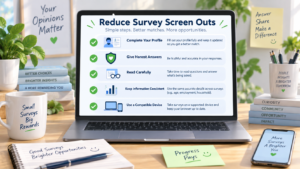
Keep your survey profile complete and current. Answer screening questions honestly. Read questions carefully instead of rushing through them. Use consistent information across your profile and surveys, and make sure the platform officially supports your location.
It is also worth checking technical requirements before beginning longer studies.
If possible, use a reliable internet connection and an up-to-date browser.
These habits will not guarantee more surveys, but they can help prevent avoidable disqualifications caused by incomplete information, inconsistent responses, or technical problems.
Should You Change Your Answers to Qualify for More Surveys?
No.
It may be tempting to change an answer when you realize what type of participant a researcher wants.
For example, you might think:
“If I say I own this product, maybe I’ll qualify.”
That can cause several problems.
First, the research becomes less useful because your response no longer represents a genuine customer.
Second, your answers may conflict with information elsewhere in your profile.
Third, platforms may restrict accounts when they detect repeated inaccurate or inconsistent responses.
There is also a practical problem.
Even if a false answer gets you past the first screening question, later questions may require detailed knowledge or experience you do not actually have.
That makes it harder to provide believable and useful answers.
The better strategy is simple:
Let the survey match you—not the other way around.
Do Legitimate Survey Sites Disqualify Participants?
Yes.
Being disqualified does not automatically mean a survey platform is fake.
Screening is a normal part of market research because different studies need different types of participants.
A legitimate survey company may still screen you out because of your demographics, location, purchasing habits, or a filled quota.
The important question is not:
“Does this platform ever disqualify people?”
A better question is:
“Does this platform handle survey participation transparently and reasonably?”
Look at the overall experience.
Does the site explain how its reward system works?
Can you find clear privacy information?
Are payment requirements transparent?
Does customer support exist?
Are the earning claims realistic?
Those factors provide much more useful information about a platform than the fact that screening occurs.
If you are unsure where to start, read our guide on How to choose legitimate paid survey sites before registering with a new platform.
When Too Many Survey Disqualifications May Be a Warning Sign
Screen-outs are normal. A poor user experience is not something you have to accept indefinitely.
Pay attention if you repeatedly spend a significant amount of time answering detailed questions before being told you do not qualify.
Also be cautious if the platform:
does not clearly explain rewards, constantly promotes unrealistic earning amounts, makes it difficult to understand redemption requirements, or provides no meaningful support when something goes wrong.
One or two frustrating surveys do not necessarily mean the entire platform is bad.
Look for patterns.
If the same problems keep happening, you may decide that your time would be better spent trying a different platform.
Ravtar Paid Online Surveys provides a directory where you can explore and compare different survey and reward platforms before deciding which ones interest you.
Is Getting Screened Out a Waste of Time?
Sometimes it certainly feels that way.
If you answer only two or three demographic questions before being screened out, the process has at least ended quickly.
The experience becomes more frustrating when you spend several minutes answering what feel like full survey questions before being disqualified.
Some platforms may provide a small amount of compensation for certain unsuccessful attempts, while others do not. Policies vary significantly.
This is worth checking before you commit much time to a platform.
You can ask:
How quickly does the platform usually identify whether I qualify?
Does it explain what happens after a screen-out?
Does the overall reward structure make the time worthwhile for me?
Your own experience matters.
A platform that works well for another person may not necessarily be a good fit for you.
Frequently Asked Questions
Why do I keep getting disqualified from paid surveys?
You may not match the demographic group the researcher needs, the survey quota may already be full, or your location and profile may not meet the study requirements. In some cases, inconsistent answers, attention checks, or technical issues can also cause a screen-out.
Can I completely avoid getting screened out?
Probably not. Researchers recruit specific groups for different studies, so no participant will qualify for every survey. You can reduce avoidable disqualifications by keeping your profile accurate, reading carefully, and answering consistently.
Do you get paid if you are disqualified from a survey?
It depends on the platform and study. Some platforms may provide a small reward or entry into a drawing for certain screen-outs, while others provide no compensation. Check the platform’s reward policy before participating.
Does my country affect survey eligibility?
Yes. Many studies are limited to particular countries or regions. Survey availability can therefore vary significantly depending on where you live.
Can a VPN cause problems with paid surveys?
It can on some platforms. Survey companies may need accurate geographic information, and certain platforms restrict VPN use. Check the site’s terms before using a VPN while participating.
Should I change my profile to qualify for more surveys?
Only update your profile when your real circumstances change. Providing false information simply to qualify can create inconsistent responses and may violate the platform’s rules.
Are survey disqualifications a sign of a scam?
Not by themselves. Legitimate market research studies frequently screen participants. However, repeated lengthy screen-outs combined with unclear payouts, unrealistic promises, or poor transparency may be reasons to reconsider a platform.
Final Thoughts
Getting disqualified from paid surveys can be annoying, but it is often a normal part of market research rather than a sign that something has gone wrong.
Researchers need specific participants, quotas fill up, locations matter, and not every study will match your profile.
The most useful habits are straightforward: keep your information accurate, answer honestly, pay attention to the questions, avoid rushing, and choose survey platforms that operate transparently.
Most importantly, keep realistic expectations.
Paid surveys may provide occasional rewards, but the number of opportunities you receive will vary. No trustworthy platform can guarantee that you will qualify for every survey or earn a fixed amount.
If one platform produces more frustration than value, compare your options.
Your time matters too.
Ready to Explore Survey Platforms?
Visit Ravtar Paid Online Surveys to discover survey websites and reward apps, compare your options, and find practical tips before joining.